News
Mar 11, 2026
Meet the expert: Q&A with Roger Smith, Director

In this post we go behind the scenes to meet Hesselberg Erosion Protection director Roger Smith. In this wide-ranging chat, he explores the impacts of climate change on what Hesselberg does, how he got into the industry, what motivates him and how he likes to relax.
Could you tell me about your career journey and what led you to specialise in erosion protection? What drew you to this sector and how did you come to join Hesselberg?
I graduated with a civil engineering degree but wasn’t yet sure which sector I wanted to enter. I looked around at various specialisations and working with water appealed to me most, so I started out as a site engineer for a contractor working in the industry. Hesselberg Hydro – as it was known then – was a contractor on the second project that I supervised, so I’ve worked with the business almost from the start of my career.
After a couple of years Hesselberg had become much busier and ultimately they offered me a job. I really liked the sound of it; I was really interested in what they did, I got on well with the people who already worked there and of course it would mean I could keep working near water. I wish I could say that, back in the 1990s, I had the foresight to see how important our work would become in the face of climate change, but that’s just a fortunate coincidence.
What does your role as director at Hesselberg involve day-to-day and which aspects of the work do you find most rewarding?
Historically Hesselberg has been a small business, run by a small team. Originally a Norwegian company, it had UK and Dutch arms and I grew through the ranks until, in 2004, I led a management buyout and became the director and owner of the UK business. We officially split from the Dutch team in 2019.
As the director, I’m responsible for overseeing the entire operation, from early involvement in the feasibility and design of projects, through budgeting, to supervision and delivery and ultimately inspection and maintenance of the finished work. As we’ve grown, I’ve leaned more into my management role, learning how to manage staff and the other operational aspects of the business.
Alongside that, these days much of my focus is on business development. I enjoy finding clients and potential clients who have problems we can help with, or who work in our area and showing them what they can do with our solutions. That’s one of the most effective ways for me to use my knowledge and experience.
I’m particularly motivated by the fact that our work protects important habitats, centres of population and farmland from flooding – that’s a really great thing to be doing. Perhaps my other motivation is a bit more subtle; I really enjoy being part of providing clean drinking water. It’s such a fundamental requirement and we need more and more of it. I really like seeing the benefit of what we do in these critically important things.
How would you describe Hesselberg's approach to erosion protection and what sets the company apart from others working in this field?
We’re unique, because we use a different product to other businesses working in erosion protection: asphalt. We’re the only business in the UK with extensive experience in applying asphalt solutions to erosion protection, scour protection and so on. That gives us two USPs: we have unique experience and we use a better product. It helps that we also have a fantastic track record and a very experienced workforce.
Asphaltic solutions have multiple advantages over concrete, rock armour and other competing erosion protection systems. Asphalt is flexible, so it’s more resilient – even in applications where it’s subject to wave impact and high-velocity currents. It also has a much lower carbon footprint – about five times less than concrete – is quicker to install, and has a very long lifespan. It’s a great waterproofing product, too, hence its suitability for reservoir linings and cores. These advantages together mean we can offer far greater value over a project’s lifetime.
What kinds of projects does Hesselberg typically work on and what challenges do your clients most commonly face when it comes to erosion protection?
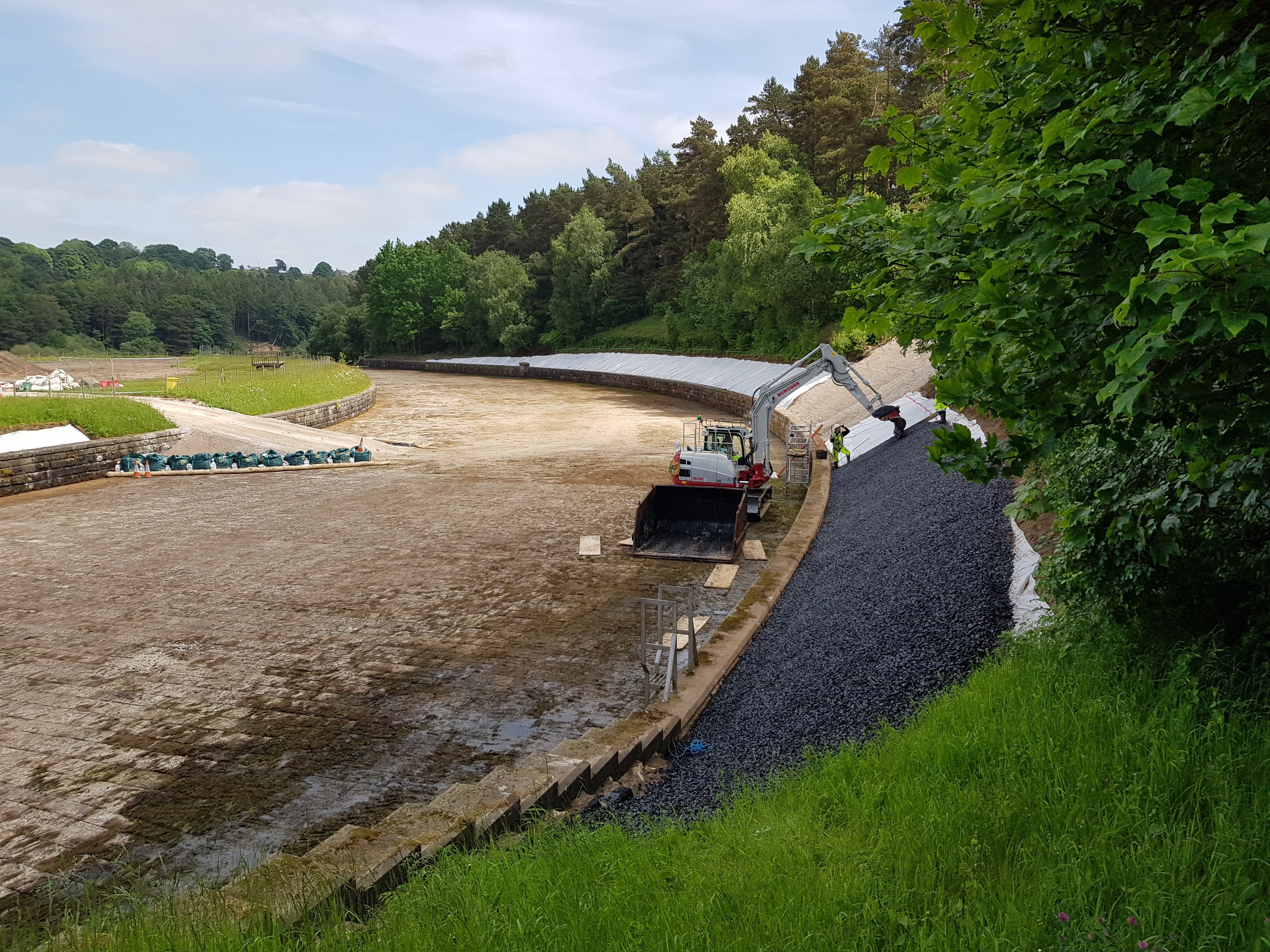
Much of our onshore work is to do with ageing assets, often belonging to or managed by the different water companies. A lot of the UK’s dams and reservoirs are well over 100 years old, so they need careful maintenance and protection to ensure they remain safe and fit for purpose. At the same time, oversight is becoming more closely scrutinised – particularly in the wake of incidents at Ulley Reservoir and Toddbrook Reservoir spillway failure, so there’s lots of work needed in that area.
Comparatively recently the government committed to building nine new major drinking water reservoirs, which would be the first in the UK for more than 30 years. That’s a developing area, where there’s also a need for waterproofing and erosion protection work.
We also work extensively with the Environment Agency on flood prevention measures. These don’t just include coastal projects, but also rivers, estuaries, and flood-storage dams, which protect towns or urban areas by limiting the flow of a river upstream from them.
In many cases, our clients are grappling with the challenges of ageing infrastructure and lower budgets, at the same time that regulation is being strengthened and the risks are being exacerbated by climate change. A good example of this is spillways, which safely channel water overflowing from a dam or reservoir. Many of these weren’t designed for the increased rainfall intensity we see today, so they can fail when water overruns the original structure. However, we can apply erosion prevention solutions to effectively increase their capacity, extending their working life and preventing failures.
A common thread is that the organisations responsible for this infrastructure face budgetary constraints. We have the advantage that asphaltic solutions can be applied on top of existing infrastructure, so we can repair and enhance what’s there with a long-term solution, rather than incurring the cost and disruption of starting over again.
Looking to the future, what are the key trends or developments in the sector? How will Hesselberg respond to them and what are your main priorities or goals for the business?
Many of the developments are being driven by climate change, which is affecting our work in two ways. From an engineering point of view, more rain and more severe storms mean problems such as coastal revetments being subject to more extreme loads, or spillways experiencing greater water volumes than they were designed for. Those kinds of changes mean there’s a need for greater, stronger protection. It may also call for more pragmatism, for example including erosion protection on the lee side of sea walls, so as to prevent damage when they’re overtopped by storms.
It also has an ongoing influence on the type of projects we’re doing. I’ve mentioned reservoirs and flood-storage dams – which offer a fantastic way of regulating water flow as rainfall becomes more extreme and less predictable. I expect we’ll continue partnering with the Environment Agency and others on more of these projects in the future.
Climate change is also important from a business perspective. Organisations are increasingly focused on their carbon emissions. Our asphalt-based materials have always had a far lower carbon footprint than many competing solutions. This is increasingly a differentiator, and a motivation for our customers, but we’re responding by trying to lower our footprint further. One example of this is that we’re evaluating the use of warm-mix asphalt instead of hot-mix, which results in further modest carbon savings. As a company we are also Carbon Neutral – Scope 1 and 2.
What do you like to do to relax?
I’m involved with the local rugby club, as Secretary, having coached and refereed juniors for over 10 years. That helps distract me from work to a certain extent. I also enjoy golf and coastal walks, along with paddleboarding – I spend an awful lot of my time on or in the water and also do plenty of travelling – some might say too much!